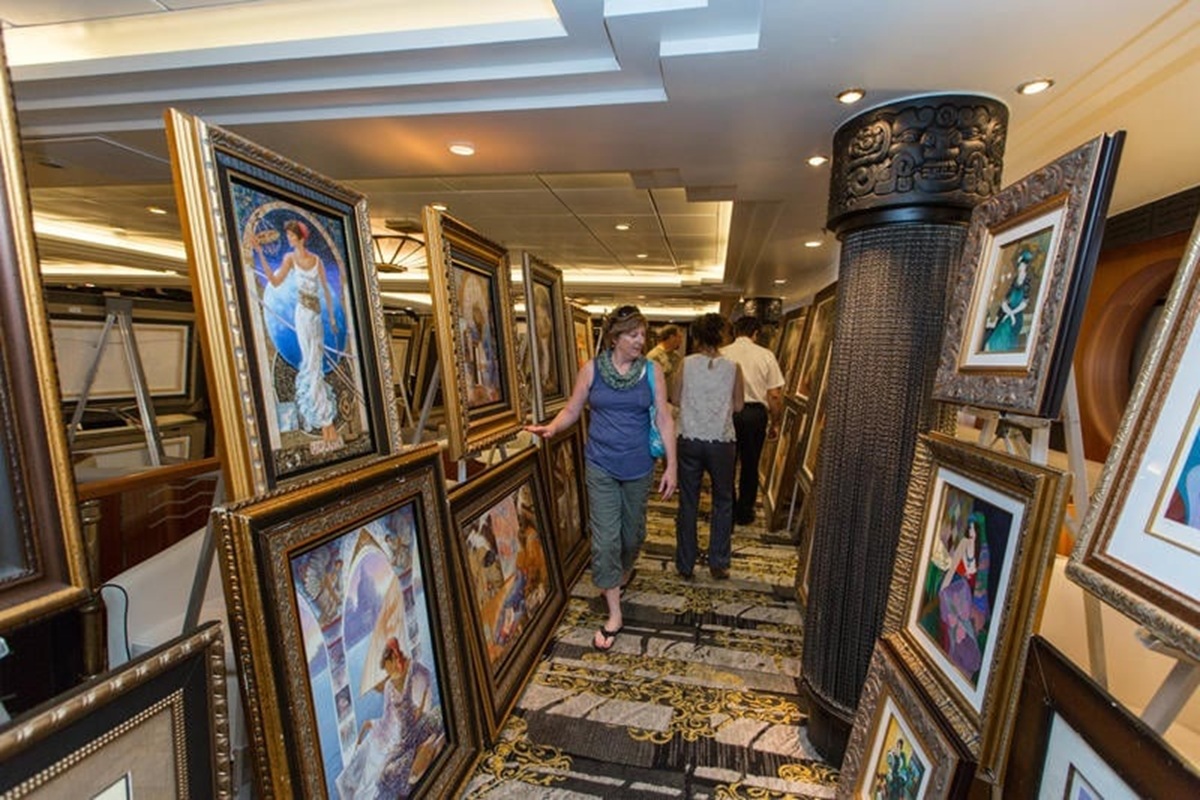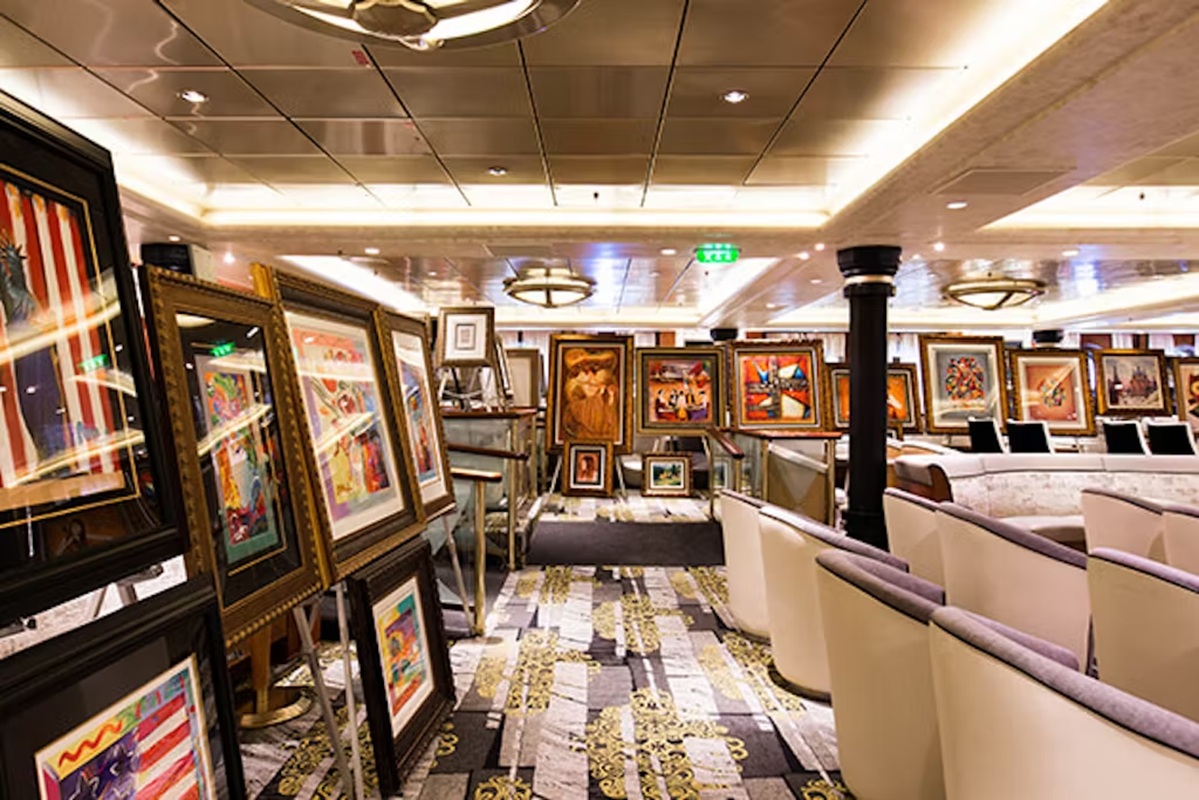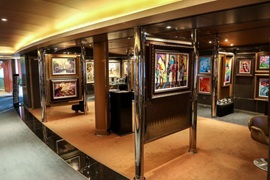
Do you take a cruise to have a chance to spend over $20,000 for a dubious piece of "art"? I sure don't.
But a lot of people do attend cruise ship art auctions. And they spend a lot of money on the prints being sold.
So here's some unsolicited advice from me as to why you should NOT go to those art auctions.
Scam is a harsh word. And, if I were putting this in front of the general public, I'd probably use something more mealy-mouthed. But this is just in the family, and I'm less concerned about being sued by the cruise lines or by Park West here than if this were posted on a public web site.
I'm calling this a scam because of a) what's being sold, b) who's doing the selling and what they're saying about the art, c) the absurd valuations of the art along with the prices being extracted from the buyers for dubious works by mostly unknown artists, c) the tactics and gimmicks being employed by the auctioneers, and d) the lawsuits against Park West (with additional retaliatory action taken by a cruise line).
Much of the information on this page is taken from a 2019 article by Sarah Cascone, a Senior Writer for artnet a well-regarded international research and trading platform for the art market which has been around since 1989 and has both an online presence as well as a brick-and-mortar presence. Since 2004, artnet has been in collaboration with international auction house, Sotheby's. Some additional information came from a 2020 article by Andrea M. Rotondo on the Cruise Critic website.
But it's important to note that all the opinions expressed on this page, particularly the use of the word "scam" are Lee's. Any factual errors or misstatements are his responsibility as well.
One other very important distinction. Do not confuse the works in the Art Auctions (which are displayed in the Art Gallery on the ship) with the ship's Art Collection. The pieces in the Art Collection are on permanent display throughout the ship, are not for sale, and are genuine and legitimate works of art. Apples and oranges.
Let's start with a little bit about the company. As I'm writing this, all art auctions on board Holland America ships are run by Park West Galleries. (But see "The Future of Shipboard Art Auctions" section below; this could be changing.) Founded in 1969 by Albert Scaglione, Park West says it operates on 100 cruise ships and claims that its art on just one of them is worth three million dollars. Park West reportedly represents some 200 artists and holds approximately 1,200 auctions every month.
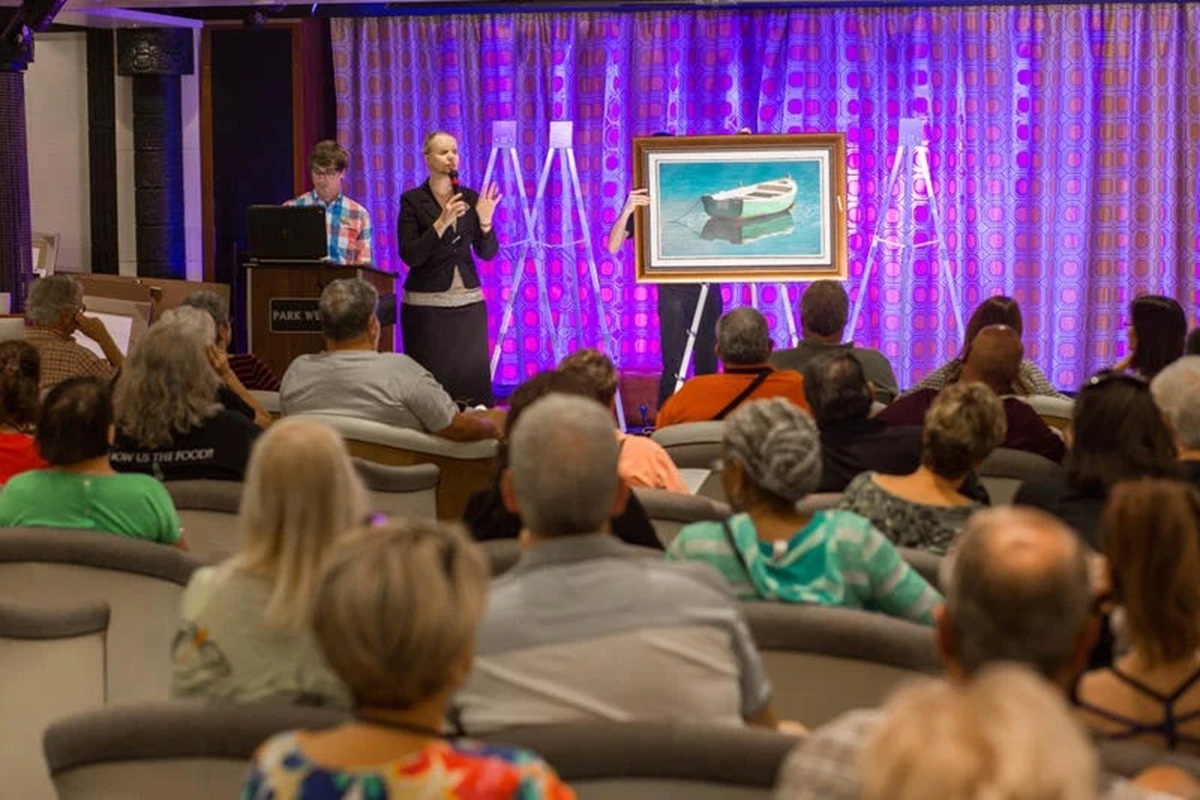
For most art world organizations, the employees are hired largely on the basis of their expertise in art. This doesn't seem to be the case for Park West. The auctioneer on Sarah Cascone's cruise listed six years in fine jewelry and watch sales at Louis Vuitton Moet Hennessy before joining Park West. Other auctioneers and art directors at Park West had experience in HVAC, used car sales, fitness instruction, and the Royal Caribbean Cruise Line Beverage Team according to Cascone.
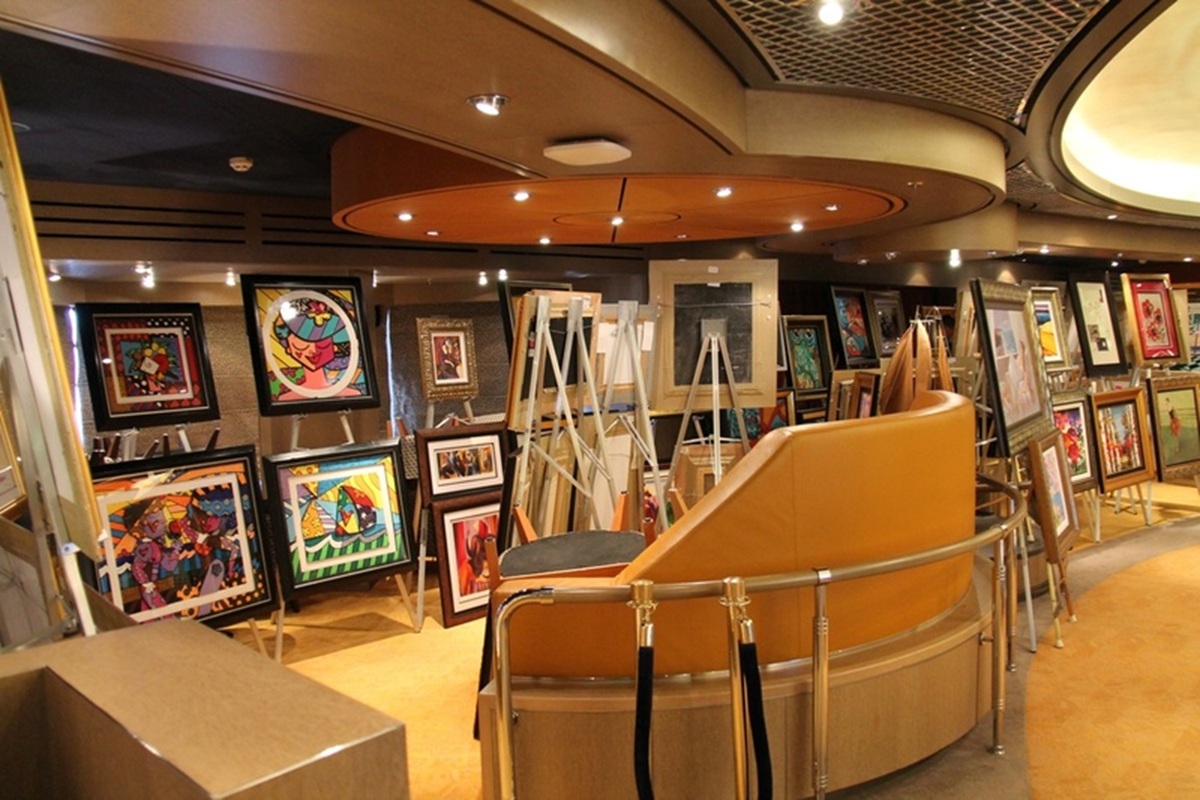
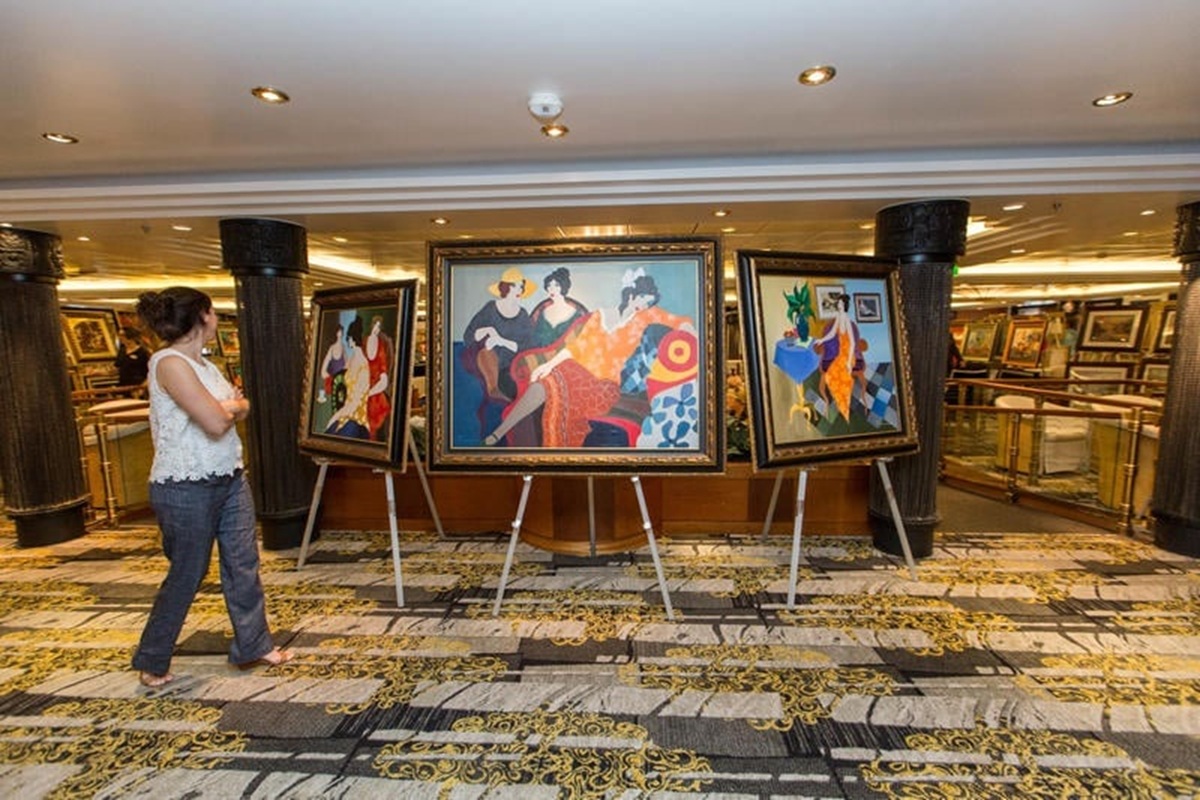
But where traditional auction houses operate on the secondary market, selling works consigned by private collectors, Park West specializes in what it calls "graphic works". These are mass-produced reproductions of original paintings, signed by the artist and released in "limited" editions. Some are giclee prints - a fancy term for high quality inkjet prints. Some other pieces may look like oil paintings, but these more expensive offerings are often merely hand-embellished, with brushstrokes layered over a printed image to give it a more "authentic" feel.
Park West says, "They look like a unique one-of-a-kind, they feel like a unique one-of-a-kind, just at a fraction of the price." The representative continued, "If we look at the Oxford Dictionary of Art, every single artwork that can be traced back to the artist or was created under the artist's supervision is considered to be an original work of art."
Of course, virtually all the works sold at these art auctions are anything but unique. In fact, most of the time, you won't even take home the exact work you're bidding on. Park West will ship you a functionally identical copy from its warehouse, rather than going through the trouble of turning over the on-board stock, according to Bloomberg Business. Bloomberg also reported in 2016 that, since 2008, Park West had been subject to nearly a dozen lawsuits alleging abusive sales practices. (See "The Lawsuits" section below.)
The art being sold is represented to be original works and limited editions from the artists. Auction houses provide a Certificate of Authenticity (COA) for each piece in their inventory. The COA should describe the work in detail. In particular, take note of what entity authenticated the work. For example, Claude Picasso and Maya Windmaier Picasso are the definitive word on any piece by Pablo Picasso. Unfortunately, many believe that the vast majority of COAs aren't worth the paper they're printed on. The COA (in the case of limited editions) should be signed by the artist or publisher. The artist's agent, a respected art expert, or an established dealer might also sign a COA. Does anyone really believe that the purchasers of art in a cruise ship lounge are in any position to determine if a COA is worthwhile.
And then we come to the topic of appraisals. On a cruise ship, there is no way you can get a third-party appraisal of a piece of art. Park West will tell you what they have appraised the piece for, but that appraisal is worth about as much as a COA signed by your former used car salesman. The auction house appraisals, particularly for artists unknown except in cruise ship lounges, are notoriously and extravagantly inflated.
However, to my mind the biggest red flag about the art is that the vast majority of the works sold in Park West auctions at sea are by artists who are unknown outside the world of Park West auctions such as David Najar, Marko Markovic, David Le Batard, and Slave Ilyayev. Have you ever heard of any of them? Try googling them and see what pops up. And give a thought to how valuations of works by artists who are only known in the context of Park West auctions would be generated.
The first piece of art at the auction Sarah Cascone attended was a piece by Peter Max. Unlike many of the artists in the Park West auctions, Peter Max is not an unknown. Max is a well-known Pop artist who met Park West's founder in the late 1960s and has been represented by him ever since. Unfortunately, Max has suffered from dementia and stopped painting, allegedly signing pieces churned out by assistants. According to the New York Times, the artist's daughter has sued the gallery for underpaying for his works and Park West has countersued, alleging breach of contract. (See the next section for a description of the bidding and sale of that Max piece.)
Park West and other galleries doing business at sea have been the subject of a number of lawsuits, the most serious alleging sale of inauthentic art, inflated appraisals, misrepresentation, and fraud.
For example, Lisa Cornell of Weston, Florida purchased art on a Princess Cruise in 2007, but alleged that the works she received after the voyage were different pieces. She canceled the order and sued for $585. Carnival Corp, the parent company of Princess (and of Holland America) ended up blacklisting Cornell from all its cruise lines. Cornell had to go to court again to contest the blacklisting and in 2017, the lifetime ban was overturned.
In 2009, The Independent reported that one passenger was removed from a cruise for warning guests to be careful buying expensive art from Park West.
Additionally, passengers who have purchased art on various ships have complained of long delivery delays, art arriving in the wrong or a damaged frame, and shill or phantom bidding during the auction. Additionally, buyers have frequently determined that they have overpaid for the art, sometimes massively. The Cruise Critic article argues that overpaying isn't the gallery's fault, that it's the buyer's responsibility to determine the market value of a piece of art. Personally, I find the argument specious given the tactics and inflated "reserve" prices and minimum starting bids I describe below. Park West certainly knows and expects that the people at the on-board auctions didn't come on the cruise as art connoisseurs looking for a purchase. They were lured into a lounge with the promise of free alcoholic beverages and a diverting way to spend an afternoon at sea. Expecting that these folks would even know how to research the values of much of the art being sold by Park West is unreasonable and absurd.
I've saved this topic for almost the end because, at least for me, it represents the fundamental dishonesty of the at-sea art auction. First, the auctions are packed to the gills with gimmicks.
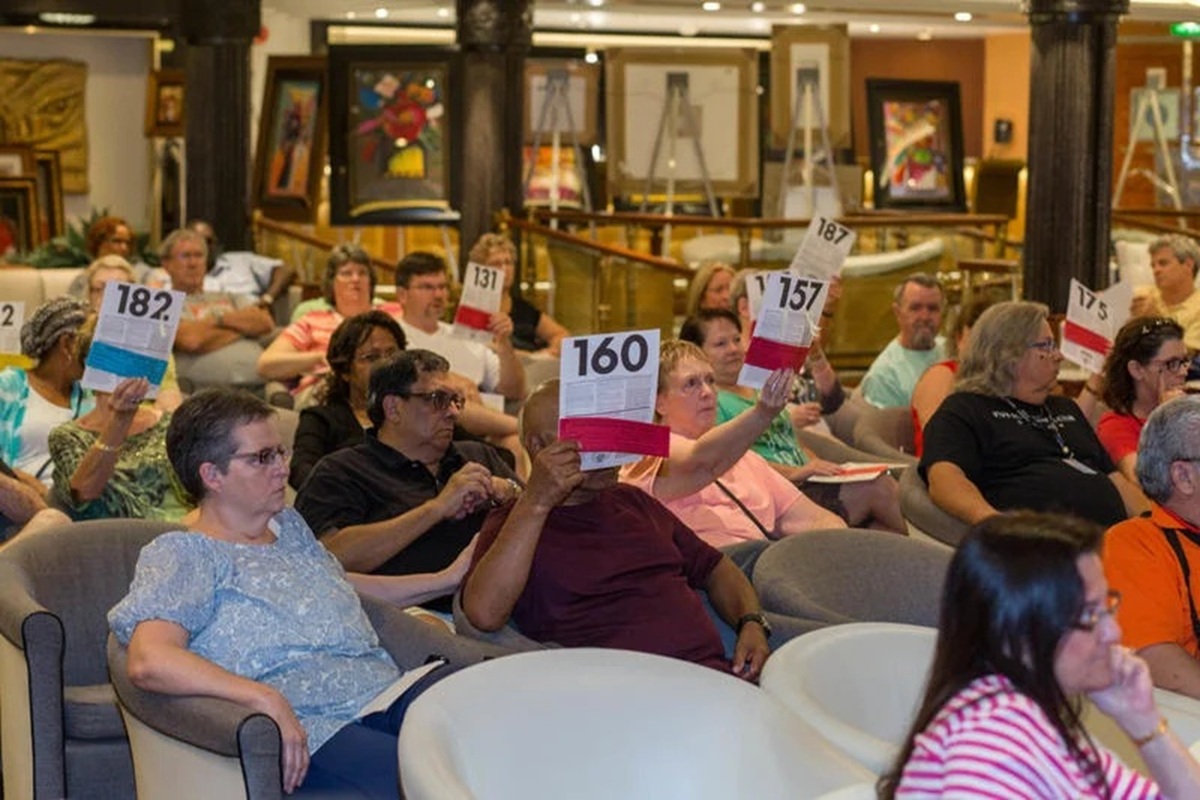
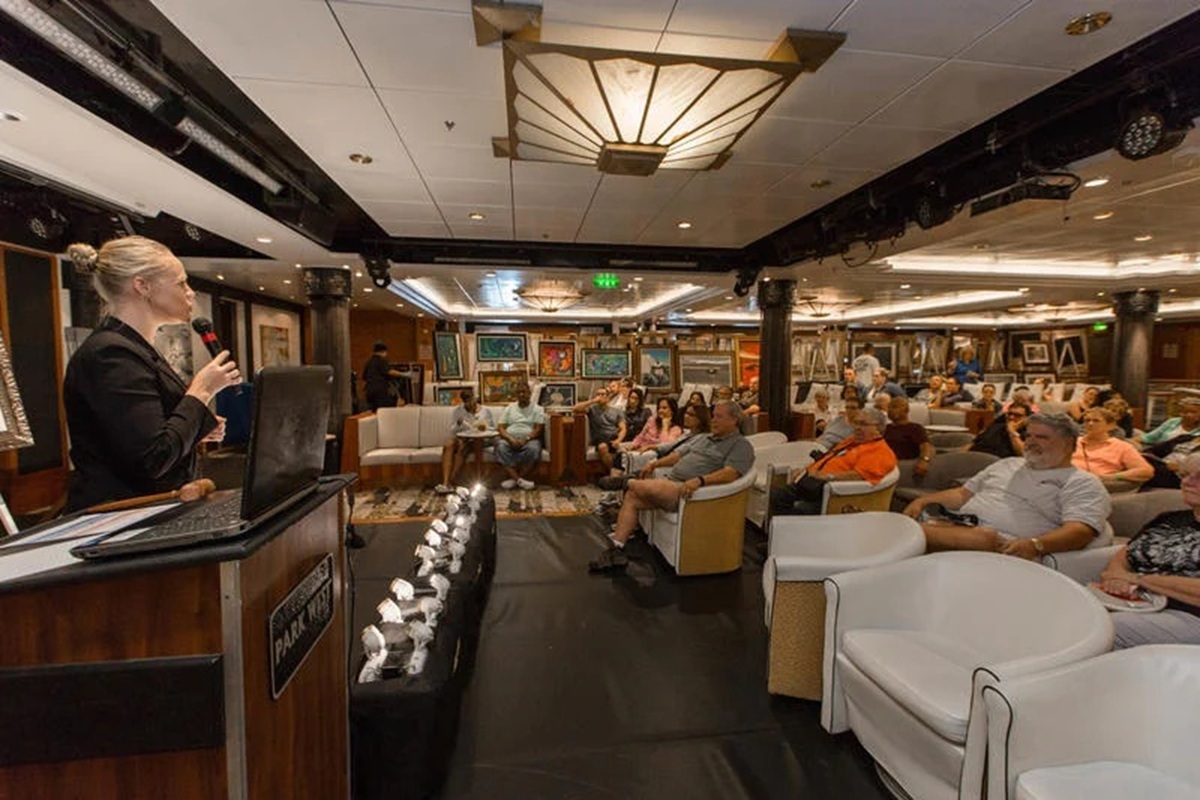
As you enter, there will be a registration table where you'll have your ship card scanned, sign a paper you won't read, and receive a "Bidding" card with a number on it which you'll hold up to bid in the auctions. As soon as you sit down, you'll be plied with free glasses of sparkling white wine. (After two glasses of wine, I'd probably bid $1,000 for a copy of the Daily Program.)
At the auction Sarah Cascone attended, the auctioneer began by saying, "I don't know if you've seen Oprah," he said. "We have some surprises under the chairs." In a frenzy, the few guests in the room rushed to upturn every seat cushion. No car keys were found but there were $100 certificates for discounts on winning bids. The auctioneer then began offering additional raffle tickets for $100 credits throughout the auction. After every lot, he would encourage attendees to wave their bid cards promising the discount to whoever was first in the air. Every time, he'd credit two, three, or four bidders with being "first." EVERYONE IS A WINNER!!! Trust me, you don't see this at Sotheby's.
One gimmick in particular stood out to Cascone. Two works were presented for auction, turned away from the audience and sold as a single lot, without the buyers having any idea of what they were buying or what they looked like. The auctioneer said, "They are going to be two of the most gorgeous works of art that anyone has ever seen." He promised the audience, "Once you turn it around, if it's something you don't like, you don't have to keep it." The works turned out to be by David Najar, one of the "Park West Unknowns". At that auction, the pair of mystery paintings were sold for $1,490 with the auctioneer tossing in a third work by Najar as a bonus.
And then there was Tweety. You know Tweety, the Loony Toons character who "tought he taw a puddy cat". The auctioneer never named the artist responsible for designing the tiny print (which was just a few inches high, and thus impossible to see across the room). Somehow, he connected the tiny print to Rembrandt. He said, "Rembrandt was doing etchings 500 years ago. Tweety was done using the same technique." Somehow, this tiny print was valued at $549. The auctioneer then said, "Let's have some fun," and instructed everyone to hold up their bid card. He opened the bidding at $20. Two-thirds of the crowd dropped out when he raised the price to $40, then he suddenly slammed down the hammer, selling the cartoon bird to a handful of guests.
Then when Cascone, amused by what she described as "Sotheby's for Dummies," decided to take a video of the auctioneering, she was immediately spotted by the auctioneer, told to stop, and a security guard was sent to warn her that she was not allowed to make recordings. Remembering the passenger who was kicked off the ship for critical remarks, she stopped recording and left.
But here's the kicker, at least from my point of view. Remember when I mentioned that first piece auctioned was a Peter Max work. The auctioneer described it as a "Printed Painting on canvas," and said that it was valued at $23,500, but that he could start the bidding at $20,000. Thirty seconds later, the work was sold for $20,700. This is the issue: While Max has decades of experience exhibiting at international museums, and the highest auction price recorded for a work of his is $53,125 according to the artnet Price Database. But that one price is an outlier. Among nearly 2,000 Max sales recorded, only two other works by the artist sold by a serious auction house went for more than $20,000. This makes the valuation and the starting bid absolutely absurd. Using that unrealistic and unbelievable number seems like theft to me.
A number of cruise lines have ended their art auctions. There are no longer any art auctions on Oceania, Crystal, Windstar, or Regent Seven Seas Cruises. Disney Cruise Line also eschews art auctions, but sells art (mostly Disney-themed) including posters, one-of-a-kind paintings, lithographs, and animation cels from its films, but everything in their Vista Art Gallery is marked with a price tag, and those prices, while relatively expensive (as is everything at sea), are commensurate with the value of the items being sold.
If, despite everything you've read here, you decide that you want to buy something at an Art Auction, please don't expect it to be an investment. Only buy it if you want it on your wall, and you feel that looking at it every day for the next 20 years will bring you pleasure. And that the price you're paying is fair value for that viewing experience over time.
And please do keep in mind that anything you spend at an art auction on the ship will not be among the included costs that Lee will pay. It will definitely be coming out of your own pocket.
Click on a photo to see a gallery of large images.